
 EN
EN  English
 简体中文
简体中文
Premium quality since 2002!
What Polyester Conductive Yarn Fabric Actually Is
Polyester conductive yarn fabric is a textile material in which electrically conductive elements — most commonly metal-coated fibers, carbon-loaded filaments, or stainless steel threads — are integrated into a polyester yarn structure, which is then woven, knitted, or otherwise constructed into a finished fabric. The result is a textile that combines the familiar mechanical characteristics of polyester — dimensional stability, durability, chemical resistance, and ease of processing — with measurable electrical conductivity that standard polyester alone cannot provide. The fabric can carry electrical signals, dissipate static charge, shield against electromagnetic interference, or serve as a flexible electrode, depending on how the conductive yarn is engineered and how the fabric is constructed.
The distinction between a conductive polyester yarn fabric and simply a polyester fabric with a conductive coating applied afterward is important. Post-production coatings — such as silver-coated or carbon-coated fabrics — can wash off, crack with flexing, or delaminate over time, degrading their conductivity in service. A conductive polyester yarn fabric integrates the conductive element at the fiber or yarn level, making conductivity a structural property of the textile rather than a surface treatment. This construction approach produces a fabric whose electrical performance is inherently more durable, wash-resistant, and mechanically stable than coated alternatives, which is why it is specified for demanding applications in electronics, medical devices, protective workwear, and smart textiles.
How Conductive Polyester Yarn Is Made
The manufacturing approach used to create conductive polyester yarn determines the fabric's final resistivity range, flexibility, durability, and cost. There are several distinct production routes, each with different performance trade-offs that make them appropriate for different end applications.
Metal-Coated Polyester Filaments
The most widely used approach for producing electrically conductive polyester yarn is the deposition of a thin metallic layer — typically silver, copper, or nickel — directly onto the surface of individual polyester filaments before or after they are twisted into yarn. In electroless plating, the polyester filament is chemically sensitized and then immersed in a metal salt solution, triggering a reduction reaction that deposits a uniform metallic layer as thin as 100 to 500 nanometers across the entire filament surface, including the crevices between adjacent filaments in a multifilament bundle. Silver-coated polyester yarn produces the lowest surface resistivity of any commercially produced conductive polyester textile — typically in the range of 0.01 to 1 ohm per square — making it suitable for electromagnetic shielding and biopotential sensing. Copper-coated variants achieve similar resistivity at lower material cost but are more susceptible to oxidation, which raises resistance over time unless a protective overcoat is applied. Nickel-coated polyester yarn falls between the two, offering moderate conductivity with better oxidation resistance than copper.
Carbon-Loaded Polyester Fibers
An alternative to metal coating is the incorporation of carbon black or carbon nanotubes directly into the polyester polymer melt before extrusion. As the polymer is spun into filaments, the carbon particles form a conductive network within the fiber cross-section rather than on its surface. Carbon-loaded conductive polyester fibers typically achieve surface resistivities in the range of 10³ to 10⁸ ohms per square — significantly higher resistance than metal-coated variants, placing them in the antistatic rather than the highly conductive category. This resistivity range is ideal for electrostatic discharge (ESD) protection applications where complete conductivity would actually be dangerous, and where controlled charge dissipation is needed instead. Carbon-loaded fibers are also inherently more wash-stable than surface-coated alternatives because the conductive element is distributed throughout the fiber volume rather than concentrated at a surface layer that can abrade or wash away.
Stainless Steel and Metallic Core Blends
Some conductive polyester yarn fabrics are produced by wrapping or plying very fine stainless steel filaments — typically 8 to 25 microns in diameter — with polyester fibers or by spinning them together into a blended yarn. The stainless steel provides the electrical conductivity while the polyester component contributes tensile strength, elasticity, and comfortable hand feel. These blended yarns are used in applications where the fabric must withstand repeated mechanical stress — such as in protective gloves, heating elements in smart clothing, or ground straps in industrial workwear — because the polyester component buffers the inherently brittle stainless steel filaments against fatigue failure from repeated bending. The resistivity of stainless steel blend conductive polyester yarn typically falls between 10² and 10⁵ ohms per square, depending on the percentage of metal in the blend and the yarn construction geometry.
Key Electrical Properties and What They Mean for Your Application
When evaluating or specifying a polyester conductive yarn fabric, the electrical specification that matters most depends entirely on what the fabric needs to do. Using the wrong conductivity range — or misinterpreting the specification — is a common source of underperformance in conductive textile applications.
| Resistivity Range (Ω/sq) | Classification | Typical Yarn Type | Primary Applications |
| < 1 Ω/sq | Highly Conductive | Silver-coated polyester | EMI shielding, biopotential electrodes, heated textiles, signal transmission |
| 1–10² Ω/sq | Conductive | Copper-coated, nickel-coated, stainless blend | Resistive heating elements, touch sensing, capacitive electrodes |
| 10² – 10⁵ Ω/sq | Dissipative / Antistatic | Carbon-loaded polyester, low-density metal blends | ESD protective workwear, cleanroom garments, antistatic flooring |
| 10⁵ – 10⁹ Ω/sq | Static Dissipative | Lightly carbon-doped polyester | Packaging materials, light industrial ESD control, agricultural applications |
It is also important to understand that resistivity is measured differently depending on the test standard being applied, and values from different suppliers may not be directly comparable if they were measured under different conditions — humidity, temperature, sample preparation, and electrode spacing all affect the reading. When sourcing conductive polyester yarn fabric for a critical application, always request the specific test method alongside the resistivity value, and if possible test a sample under conditions that replicate your actual use environment.
Fabric Construction: How Weave and Knit Structures Affect Conductivity
The way a conductive polyester yarn is constructed into a finished fabric significantly affects the fabric's overall electrical performance, even when the yarn's intrinsic resistivity is fixed. Understanding these construction effects helps avoid the common mistake of specifying an excellent conductive yarn that is then built into a fabric structure that undermines its electrical properties.
Woven Conductive Polyester Fabric
In a woven conductive polyester fabric, the conductive yarns can be incorporated in the warp direction only, the weft direction only, or in both — and the choice determines whether conductivity is anisotropic (directional) or more isotropic (equal in all directions). A fabric with conductive yarn running only in the warp direction will show much lower resistance measured along the warp than across it. This anisotropy can be exploited intentionally — for example, in a sensing grid where warp and weft conductive elements must be independently addressable — or it can be a problem if uniform conductivity across the fabric surface is required. Fabrics with conductive yarn in both directions and a tight enough weave to ensure good yarn-to-yarn contact at the crossover points approach isotropic conductivity and lower overall surface resistance.
Knitted Conductive Polyester Fabric
Knitted construction is often preferred for applications where the conductive polyester fabric must be elastic or conform to a three-dimensional surface — wearable electronics, medical garment electrodes, and smart sportswear are typical examples. The interlocking loop structure of a knit creates a fabric that stretches significantly in multiple directions without the yarn breaking, which is critical in body-worn applications where the textile must move with the wearer. The trade-off is that the loop geometry means conductive yarn-to-yarn contact is intermittent and load-dependent — when the fabric stretches, the loops separate slightly and resistance increases. This resistance-versus-stretch relationship must be characterized for each fabric if it is to be used as a stretch sensor or if stable low resistance is needed under deformation.
Spacing and Density of Conductive Yarn
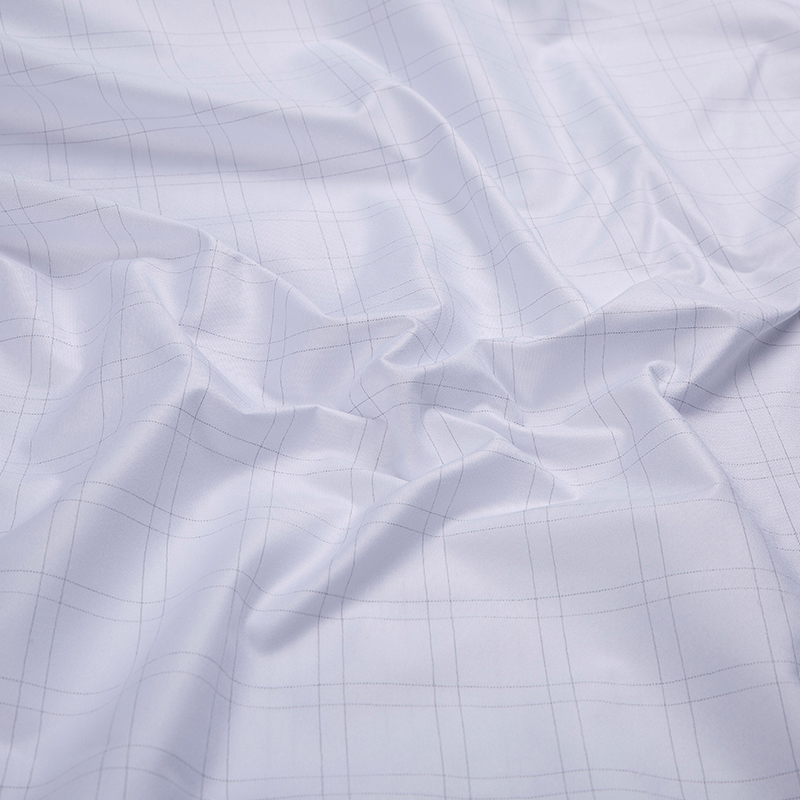
Not every yarn in a conductive polyester yarn fabric needs to be conductive — and often it is more economical and mechanically appropriate to intersperse conductive yarns within a predominantly non-conductive polyester ground fabric. The conductive yarns are typically spaced at regular intervals measured in millimeters, and this pitch determines the fabric's grid spacing for sensing applications, the uniformity of static dissipation, and the overall material cost. A finer pitch — more conductive yarns per unit width — produces lower surface resistance and more uniform charge dissipation but raises cost and may affect the fabric's hand feel and drape if the conductive yarn is significantly stiffer than the ground yarn. The optimal pitch is always application-specific and should be validated empirically rather than assumed from first principles.
Where Polyester Conductive Yarn Fabric Is Used in Practice
The practical applications of electrically conductive polyester fabric span a remarkably broad range of industries, united by the requirement for a material that is simultaneously a functional textile and an electrical component. The following sectors represent the largest and most technically demanding uses.
Electromagnetic Interference (EMI) Shielding
Silver-coated conductive polyester woven fabric is extensively used as a flexible EMI shielding material in electronics enclosures, cable wraps, medical equipment housings, and military applications. The shielding effectiveness of a conductive textile depends on its surface resistivity, the frequency of the electromagnetic radiation being shielded, and the fabric's construction — specifically, the size of the apertures between yarns relative to the wavelength of the radiation. A tightly woven fabric with very low surface resistance can achieve shielding effectiveness of 40 to 80 dB across a broad frequency range, making it competitive with thin metallic foil in applications where the flexibility and sewability of a fabric are advantages. Polyester is the preferred base fiber for most EMI shielding applications because its dimensional stability under varying humidity and temperature keeps the aperture geometry consistent, preserving shielding performance in service.
ESD Protective Workwear and Cleanroom Garments
In semiconductor manufacturing, pharmaceutical cleanrooms, explosive handling environments, and electronics assembly, workers must wear garments that prevent the buildup of electrostatic charge that could damage sensitive components or ignite flammable atmospheres. Carbon-loaded conductive polyester yarn fabric in the dissipative resistivity range (10³ to 10⁵ ohms per square) is the standard material for ESD protective workwear because it dissipates charge at a controlled, safe rate — fast enough to prevent dangerous charge accumulation but slow enough to avoid the instantaneous discharge that could damage a sensitive semiconductor junction. The garments are typically constructed with conductive grid fabrics that connect to a ground point through a wrist strap or heel grounders, creating a complete dissipative path from the person's body to earth ground.
Wearable Sensors and Smart Textiles
The emergence of wearable health monitoring and human-machine interface applications has created significant demand for conductive polyester knit fabrics that can serve as body-worn electrodes, pressure sensors, and gesture-detection surfaces. Biopotential measurement — capturing electrocardiogram (ECG), electromyogram (EMG), or electroencephalogram (EEG) signals from the body surface — requires electrodes with low impedance, good skin contact, and stability during body movement. Silver-coated conductive polyester knit electrodes have been validated in clinical research as acceptable dry electrodes for ECG monitoring during exercise, where the combination of elasticity, low resistance, and washability makes them more practical than the gel-based disposable electrodes used in clinical settings. Pressure-sensitive conductive polyester fabrics — which change resistance when compressed — are used in smart insoles, seat occupancy sensors, and posture monitoring garments.
Resistive Heating Textiles
When current flows through a conductive polyester yarn fabric with resistance in the appropriate range, the fabric generates heat through Joule heating — the same principle as a conventional electrical resistance heater, but distributed uniformly across a flexible textile surface. Heated garments for outdoor workers, heated seat covers, therapeutic heating wraps for medical use, and de-icing textiles for aerospace applications all use this principle with conductive polyester fabrics tailored to produce a target watt-per-square-meter output at a safe supply voltage. The design requires careful matching of fabric resistance, supply voltage, and fabric area to achieve the desired heating power without creating local hot spots that could cause burns or damage the textile. Polyester's dimensional stability is important here because the resistance of the fabric — and therefore its heating output — must remain consistent when the fabric is stretched, folded, or cycled through repeated temperature changes.
Comparing Polyester Conductive Yarn Fabric to Other Conductive Textile Options
Polyester is one of several fiber bases used in conductive yarn fabrics. Understanding how it compares to alternatives like nylon, cotton, and pure stainless steel textiles clarifies when polyester is the right choice and when another base fiber might be more appropriate.
- Polyester vs. Nylon: Both polyester and nylon accept metal coatings well and produce mechanically strong conductive yarns. Polyester has better dimensional stability under humidity changes — it absorbs very little moisture, so its electrical properties remain consistent across different environmental conditions. Nylon absorbs more moisture, which can cause resistance to shift as humidity changes, making polyester the more reliable choice for applications requiring stable electrical performance across varying conditions.
- Polyester vs. Cotton: Cotton's natural moisture absorption and softness make it attractive for skin-contact applications, but cotton's dimensional instability — it shrinks significantly when washed and swells when wet — makes it problematic for precision conductive textile applications where consistent yarn geometry and spacing are important. Conductive polyester yarn fabric maintains its construction geometry through repeated washing and use, while conductive cotton blends may show increasing resistance variation as the fabric structure changes over time.
- Polyester vs. Pure Stainless Steel Fabric: Woven stainless steel fabric achieves the lowest achievable resistivity of any textile-format material — essentially metallic conductivity across the full fabric — but it is rigid, heavy, expensive to process, and cannot be made into garment-grade softness. Conductive polyester yarn fabric with stainless steel blends captures most of the conductivity benefit of stainless steel while retaining the processability, weight, and drape appropriate for wearable and flexible applications.
- Polyester vs. Coated Non-Wovens: Non-woven fabrics with conductive coatings are lower-cost alternatives used in disposable or short-life applications like single-use ESD packaging. Their conductivity is surface-only, washes off rapidly, and offers no mechanical durability advantage. Conductive woven or knitted polyester yarn fabric is unambiguously the superior choice for any application requiring repeated laundering, mechanical durability, or stable long-term electrical performance.
Washing, Care, and Long-Term Performance of Conductive Polyester Yarn Fabric
One of the most practically important questions for buyers and users of conductive polyester yarn fabric is how its electrical performance holds up through repeated laundering. The answer depends heavily on the specific conductive yarn construction used in the fabric, and understanding this helps set realistic expectations and establish appropriate care protocols.
Silver-coated conductive polyester yarn fabric is the most laundering-sensitive of the main types. Silver coatings are susceptible to sulfidation — reaction with sulfur compounds in sweat, detergent residues, and ambient air — which converts the conductive silver surface to non-conductive silver sulfide. This is often visible as a tarnishing or darkening of the fabric, and it raises surface resistance measurably over repeated wash cycles. Using a mild, sulfur-free detergent, washing at low temperatures (30°C maximum is typical), and avoiding fabric softeners — which deposit insulating films on fiber surfaces — extends the useful life of silver-coated conductive polyester fabric significantly. Some silver-coated fabrics are additionally treated with an anti-tarnish coating during manufacturing to extend wash durability, and these should be specified for applications requiring many wash cycles such as medical garments or reusable ESD workwear.
Carbon-loaded conductive polyester yarn fabric, by contrast, is inherently wash-stable because the carbon is distributed throughout the fiber volume rather than at its surface. There is no surface layer to wash off or abrade, and the fabric's resistivity remains essentially constant through hundreds of wash cycles under normal laundering conditions. This wash durability makes carbon-loaded conductive polyester the preferred specification for ESD workwear programs where garments are laundered industrially on a frequent, regular schedule. The trade-off is that carbon-loaded fibers cannot achieve the very low resistivity levels of silver-coated fabrics — for applications requiring highly conductive fabric, the superior wash stability of carbon loading does not compensate for its inherently higher resistance.
Regardless of the conductive yarn type, conductive polyester knit and woven fabrics should not be tumble-dried at high heat, as polyester's thermoplastic nature means sustained high temperatures can distort the fabric structure and alter the yarn-to-yarn contact geometry that contributes to the fabric's measured conductivity. Line drying or low-heat tumble drying is the standard recommendation, and this practice also extends the service life of the polyester base fabric independent of any conductivity consideration.
What to Check When Sourcing Polyester Conductive Yarn Fabric
Sourcing the right conductive polyester yarn fabric for a specific application requires more diligence than sourcing a standard polyester textile, because the number of variables that affect real-world performance is substantially higher. The following checklist covers the key parameters to confirm with any potential supplier before committing to a specification:
- Surface resistivity value and test method: Request the resistivity figure in ohms per square alongside the specific test standard used to measure it (such as AATCC 76, EN 1149-1, or IEC 61340-4-1). Values measured under different standards are not directly comparable, and only knowing both figures allows meaningful cross-supplier comparison.
- Wash durability data: Ask how many wash cycles the fabric has been tested through and what resistivity change was observed. Acceptable wash durability varies by application — ESD workwear programs may require stable performance through 50 or 100 industrial washes, while a single-use medical application has no wash requirement at all.
- Conductive yarn type and metal content: Confirm whether the conductivity comes from silver coating, copper coating, carbon loading, stainless steel blend, or another mechanism. This determines not just the resistivity level but also the oxidation behavior, tarnishing risk, and care requirements of the finished fabric.
- Fabric weight and construction: Request grams per square meter (GSM) and a description of the weave or knit structure. These parameters determine the fabric's mechanical properties — tensile strength, elongation, tear resistance — which must be appropriate for the garment or product manufacturing process as well as for the end use.
- Conductive yarn spacing and grid pitch: For fabrics where the conductive yarn is interspersed within a non-conductive polyester ground, confirm the spacing in millimeters between conductive yarns in both directions. This figure is critical for sensing grid applications and for predicting the uniformity of static dissipation across the fabric surface.
- Compliance certifications: For ESD workwear, confirm the fabric meets EN 1149-3 or equivalent regional standards. For medical textile applications, confirm biocompatibility testing status. For EMI shielding applications, request shielding effectiveness data measured to MIL-STD-285 or IEEE 299 for the relevant frequency range.
